Essential Energy, 2016–2021
Twenty-plus field safety and operations apps on one set of shared services.
Around Field Portal, Essential Energy's in-house DevOps team, which we led, designed, built and ran more than twenty safety and operations apps for crews, depots and the control room. Each one replaced paper, a phone call, a spreadsheet or a filing cabinet, and all of them stand on one set of shared microservices that we architected first.
- Client
- Essential Energy, the NSW Government-owned electricity distributor
- Industry
- Energy & utilities
- Services
- Mobile & field apps, web apps, real-time dispatch, integrations, technical leadership
- Platforms
- Swift and Cordova on iOS, Node.js, Express, socket.io, React and Redux, Azure, SAP Concur APIs, Spotfire
- Our role
- We led the in-house DevOps team that designed, built and ran these apps, and set the shared architecture underneath them.
The challenge
Safety-critical work ran on paper and phone calls. Crews phoned a contact centre to log on and off when working near the network: about 70,000 calls a year. Lifting-equipment records sat in a filing cabinet at each depot, defect commentary lived in Excel, and switching steps were coordinated by voice.
Each problem was small on its own, and each was the kind business units had been solving by buying another point solution. The risk was a sprawl of systems, each with its own sign-in, its own copy of the vehicle list and its own support burden, none of them auditable in the way a regulator expects.
Our approach
We built the hard parts once. A set of shared microservices sits under every app, so each new app starts with sign-in, data and documents already solved and spends its effort on the workflow. Each app was scoped with the crews and staff who would use it, shipped as a small first version, and grown from what they told us.
Safety rules were written as plain-language, executable test scenarios before they were written as code, so the business could read exactly what the software enforces. It is the same discipline we bring to technical leadership engagements today.
What we built
Shared services first
Vehicle, Asset, Identity, Email, Blob storage, Form-to-PDF and App Configuration services, each a small Node.js API with one job and a stable contract. The email gateway was used by just about every app. Identity wrapped Okta and Azure AD, so no app handled passwords. Vehicle and Asset gave every app the same answer to "which vehicle?" and "which pole?", which mattered more than any single feature.
The first app on this platform was Field Portal, and vehicle pre-starts became their own iPad app, FIAS.
Log On / Log Off
An iOS app for crews and vegetation contractors to log on and off their work area, recording location and time automatically. Network control gets the visibility it needs if a fault occurs, without the phone call. The design choice was to make logging on faster than calling: one tap from a pre-filled task, with the location captured by the device rather than typed.
Real-time switching dispatch
Network switching is a sequence of steps carried out by field operators under the control room's direction. The Mobile Switching Application dispatches those steps to operators in real time over socket.io and enforces the safety rules in software: SCADA steps stay with the system operator, a step can never lose its only operator, and a job must be dispatch-ready before it is sent.
Those rules lived as Cucumber and Gherkin scenarios that the business signed off. A rule change started as a sentence a switching coordinator could read, became a failing test, and only then became code.
Network defect commentary
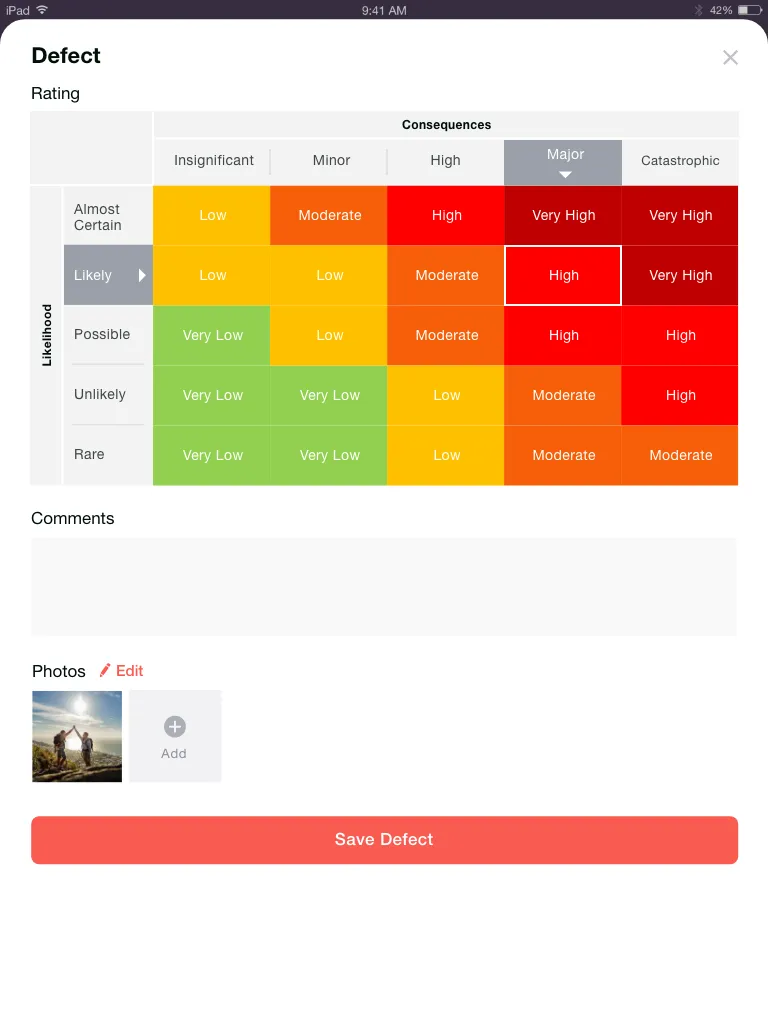
A workflow app with Spotfire analytics replaced the spreadsheets: depot-level open defects, reassignment, priority call-outs including bushfire ignition-risk rules, bulk commentary and a full audit history cross-referenced with the asset system. About 400 users supplied more than 330,000 comments on more than 250,000 critical tasks, feeding bushfire-preparedness forums and regulator reporting.
Registers, and an experience layer over SAP Concur
The Lifting Register iOS app records lifting equipment and pass or fail inspections with photos, replacing the depot filing cabinet with the database the law requires. For travel allowances, a web front end consumes SAP Concur's APIs and pre-pays the allowance as the Enterprise Agreement requires, without changing Concur. It is an anti-corruption layer: the business gets a simple workflow, and the system of record stays untouched and upgradable.
A portfolio, not a project
Around these sat smaller apps on the same services: NetOp Alerts with critical network information on screens in 150+ depots, stand-down management for the 16-hour rule, an authorisations system for licences and training, the outage notification system (ONO), drone-photo upload and a COVID-era QR check-in.
Architecture
Small apps, one platform underneath.
- Clients: native Swift and Cordova iOS apps for the field, React and Redux web apps for depots and the office.
- Real time: Node.js with socket.io for switching dispatch, so every operator sees a step change as it happens.
- Shared microservices: Vehicle, Asset, Identity, Email, Blob, Form-to-PDF and App Configuration APIs on Azure.
- Identity: Okta and Azure AD single sign-on across every app.
- Delivery: Bitbucket Pipelines, with Cucumber and Gherkin scenarios as the release gate for safety rules.
- Integration: SAP Concur behind an experience layer; Spotfire over the defect data.
Results
- 20+custom apps on shared services
- 330,000+defect comments on 250,000+ critical tasks
- ~400users of the defect commentary workflow
- 150+depots showing NetOp Alerts
Under the hood
Boring, shared foundations, so each app could be small.
- Swift
- iOS
- Cordova
- Node.js
- Express
- socket.io
- React
- Redux
- Azure AD
- Okta
- Bitbucket Pipelines
- Cucumber & Gherkin
- Spotfire
- SAP Concur APIs
What it taught us
The platform mattered more than any single app. Once identity, vehicles, assets, email and documents were solved, a new app was a workflow and a few screens, and it could be built quickly with the people who would use it. That is how we approach mobile and field apps and legacy integration today.
Lessons for today
- Build the platform under the second app, not the first. The first app tells you what is really shared. Extract services when the second app needs them, and you avoid designing abstractions nobody uses.
- Write safety rules in language the business can sign. Executable scenarios turn a compliance argument into a test result.
- Wrap systems of record; don't fight them. An experience layer gives people a simple workflow and keeps the big platform upgradable.
- Count the phone calls. The best candidates for an app are often a call, a spreadsheet or a filing cabinet that someone tolerates every day.
Questions
What kinds of apps did you build for Essential Energy?
Field and office apps for safety and operations: crew log-on and log-off, real-time switching dispatch, defect commentary, a lifting-equipment register, an outage notification system and an experience layer over SAP Concur, all on shared services.
Why build shared services before more apps?
Sign-in, vehicles, assets, email and documents are needed by nearly every app. Solving them once made each new app faster to build, consistent for users and easier to support.
How do you enforce safety rules in software?
We write the rules as plain-language Cucumber and Gherkin scenarios that the business signs off, run them as tests on every build, and only then write the code that makes them pass.
How do you improve a system like SAP Concur without replacing it?
With an experience layer: a simple front end that uses the system’s APIs and adds the business rules people need, while the system of record stays unchanged.
Related
The services behind this work, and more stories like it.
Services
Case studies

Essential EnergyAn electricity network on an iPad, offline. Field Portal: custom compression for the asset map, and a form designer that removed 3,000+ paper forms and workflows.
Essential EnergyEvery vehicle, every shift, on iPad. FIAS: scan a QR code, see the vehicle's history and open defects, and complete a guided pre-start.
Essential EnergyTelling customers when the power is out. The outage notification system (ONO) finds the customers an outage affects and notifies them by SMS or letter.
Bring us the hard problem.
A 45-minute discovery call with the engineer who'll build it.