Halfbrick Studios and THQ, 2000–2004
Real-time 3D on a 16.8 MHz handheld with no 3D hardware.
We hand-wrote a real-time 3D engine in ARM assembly for the Game Boy Advance. Halfbrick Studios used it for technology demos to Activision, THQ and Electronic Arts. The same low-level discipline now runs AI on devices and IoT at the edge.
- Client
- Halfbrick Studios (co-founded in 2000) and THQ Studio Australia
- Industry
- Games
- Services
- Real-time and low-level engineering, developer tools
- Platforms
- Game Boy Advance (ARM assembly and C); PlayStation 2, Xbox and GameCube (C and C++)
- Our role
- Our founder co-founded Halfbrick Studios and wrote its 3D engine and tools, then led AI development on a THQ console game.
The challenge
The Game Boy Advance had a 16.8 MHz ARM processor and no 3D hardware. To win publisher deals, Halfbrick had to show that full 3D games could run on it, at speeds comparable to the PlayStation.
What we did
- The engine. ARM assembly and C, with affine texture mapping, skeletal animation and collision detection, tuned down to which memory each routine lives in.
- The demos. Recreations of Starfox and Croc levels, with Croc running at speeds comparable to the original PlayStation version, a fast 3D shoot-'em-up, and texture-mapped terrain with AI-driven trucks.
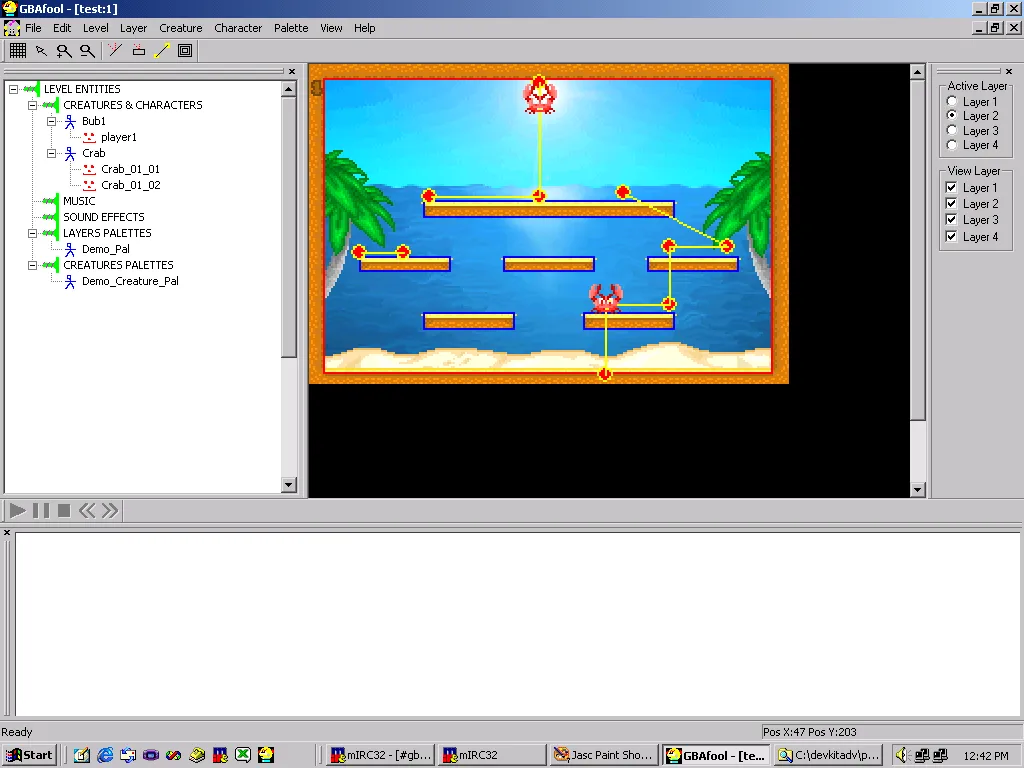
- The tools. A 2D engine built from independent subsystems, the GBAfool level and sprite editor, and 3D model converters. A port of DX-Ball took 20 hours, to prove the tools.
- The teaching. In-house course material, used to teach experienced programmers 3D games development.
- THQ, 2002–04. Real-time 3D games for PlayStation 2, Xbox and GameCube. We were lead AI developer for Goddard, the robot dog in Jimmy Neutron: Boy Genius, with path-finding that followed Jimmy through the game.
Why it matters now: if we can make a 2001 handheld render textured 3D at console speeds, we can make your app fast on a five-year-old phone, and fit a model onto the device it needs to run on.
Results
- 16.8 MHzARM processor, with no 3D hardware
- 3publishers pitched: Activision, THQ and EA
- 20 hoursto port DX-Ball and prove the tools
- 3consoles shipped for at THQ
As a co-founder of Halfbrick Studios, I had the privilege of working alongside him during an era when technical ingenuity was everything. We pushed the absolute limits of Nintendo's handheld systems, extracting every ounce of performance from their ARM-based processors through meticulously handcrafted assembly language optimisations. What we achieved with such limited hardware resources was a testament to his exceptional technical craftsmanship, relentless curiosity and deep understanding of computer architecture.
Where others saw hardware limitations, he saw opportunities for innovation. A genuine technical visionary with an extraordinary ability to solve problems at the lowest level of computing while never losing sight of the bigger picture. The kind of engineer you want alongside you when you're attempting to achieve something others consider impossible.
Under the hood
Every cycle counted.
- ARM assembly
- C
- C++
- Fixed-point maths
- Affine texture mapping
- Skeletal animation
- DMA
- IWRAM & EWRAM
- Path-finding AI
- MFC tools
Related
The services behind this work, and more stories like it.
Services
Case studies

Mobstar Games, 2004–2007Mobile since 2004. Games tuned for around 150 handsets, and branded apps for Bacardi and the BBC, years before the iPhone.

Knowby R&DHands-free help, with no cloud. An R&D prototype: Gemma 4 E2B running on the phone paired with Ray-Ban Meta glasses, reading work instructions aloud.
VariousSmaller builds and R&D. Cloud migrations, geo platforms, video pipelines and on-device experiments.
Bring us the hard problem.
A 45-minute discovery call with the engineer who'll build it.